iMedia R081 Pre Production Skills
3.4: describe the properties and limitations of file formats for moving images (animation and video)
3.4: describe the properties and limitations of file formats for moving images (animation and video)

| Keyword | Definition |
|---|---|
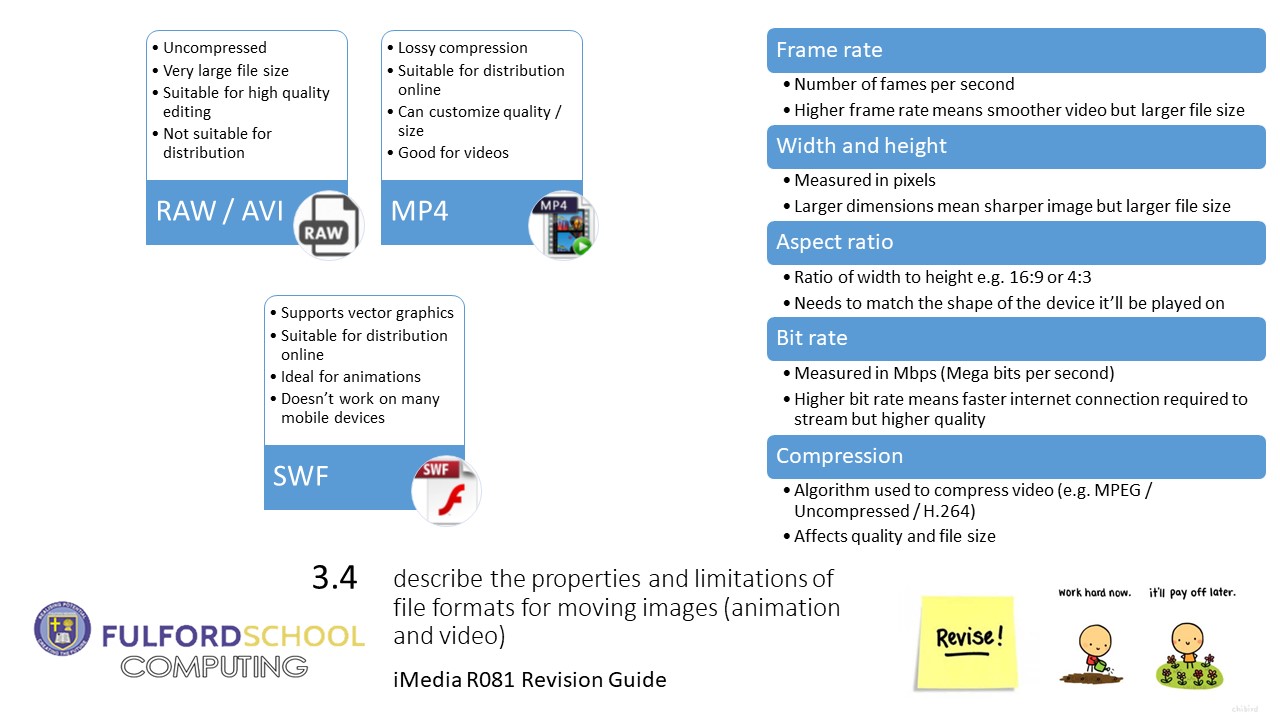
| animation | A moving picture made up of individual frames (e.g. stop motion or keyframe) |
| aspect ratio | The width divided by the height, used to show the shape of the screen a video should be played on (e.g. 4:3 or 16:9 widescreen) |
| avi | A video file format that is usually uncompressed with a very large file size, suitable for editing but not online distribution |
| bit rate | The number of bits needed to store on second of a video recording |
| compression | Technique used to reduce the file size of a video recording. Can be lossy (reduces quality) or lossless (doesn't reduce quality) |
| file size | The number of bytes used to store the video |
| frame rate | The number of images shown each second |
| height | The number of pixels down each column of a video |
| limitations | Weaknesses of a particular file format |
| mp4 | A video file format that uses lossy compression to reduce file size by reducing the picture and sound quality |
| swf | An animation file format that stores sounds, images and videos which is optimised for online distribution but doesn't work well on mobile devices |
| video | A moving picture made up of individual photos or images shown in quick succession |
| width | The number of pixels across each row of a video |